Lumetry Documentation
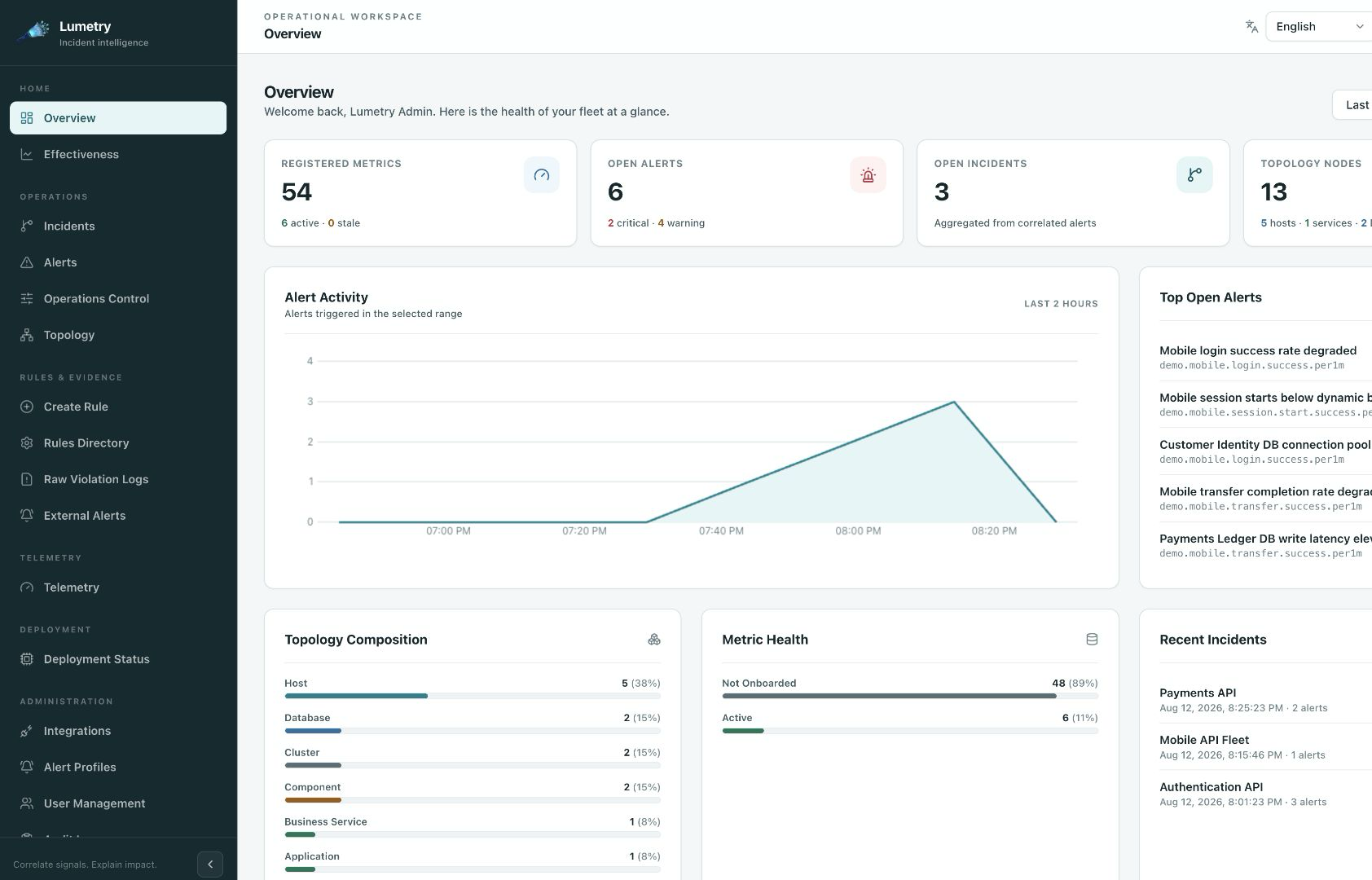
Lumetry is an incident intelligence platform. It accepts operational metrics and service-topology context, detects meaningful deviations, and turns related alerts into a smaller number of business-aware incidents.
Telemetry is an input to Lumetry, not the end product. The outcome is operational context: what changed, why it matters, which service or configuration item is affected, and which signals belong to the same incident.
The black-box model
You can understand Lumetry through its inputs, decisions, and outputs:
INPUTS
  Metric points and labels
  Metric definitions and collection settings
  Service / application / infrastructure topology
  External monitoring alarm transitions
  Detection rules and baseline settings
  Notification destinations
            |
            v
LUMETRY
  Normalizes -> evaluates -> suppresses noise -> correlates -> tracks lifecycle
            |
            v
OUTPUTS
  Violations -> operational alerts -> correlated incidents
  Service / CI impact context
  Incident timelines and affected metrics
  Notifications and integration responses
Inputs
- Metrics: pushed through the ingestion API, collected from configured sources, or sent by Lumetry Collectors running in your environment.
- Metric metadata: names, units, ownership, entities, dimensions, and evaluability state in the Metric Catalog.
- Topology: services, applications, components, hosts, databases, dependencies, and metric bindings. This can be managed in Lumetry or synchronized from a CMDB.
- Detection policy: static thresholds, learned seasonal baselines, trigger windows, recovery conditions, and Warning/Critical levels.
- External alarms: state-transition webhooks from monitoring systems, mapped by stable provider alarm identity to topology.
- Delivery policy: notification integrations and routing profiles.
Outputs
- Violations preserve the point-level evidence behind a threshold breach.
- Alerts represent actionable conditions with an open, acknowledged, and closed lifecycle.
- Incidents correlate related alerts by affected service or CI, severity, and time.
- Topology context connects technical signals to the business services they affect.
- Notifications deliver alert lifecycle transitions to configured integrations.
What Lumetry is not
Lumetry is designed to work alongside existing observability and operations tools. It is not intended to replace general-purpose dashboards, log analytics, tracing platforms, ticketing systems, or CMDBs. It consumes and enriches signals from that ecosystem so operations teams can focus on fewer, better-contextualized incidents.
Documentation map
Concepts
| Page | What it covers |
|---|---|
| How Lumetry Works | Product boundaries, inputs, decisions, outputs, and the end-to-end operational flow. |
| Directory-Based Access | Read-only LDAP/AD federation and directory-group role mapping for managed deployments. |
| Metrics & the Metric Catalog | Metric identity, ownership, collection, and the lifecycle that controls evaluability. |
| Collectors | Outbound collection, enrollment, offline buffering, configuration, and lifecycle. |
| Host Agents | Rule packs, fleet controls, process cardinality, Windows/IIS collection, and defaults. |
| Installing Host Agents | Linux and Windows enrollment, service lifecycle, collector routing, and uninstall. |
| Rule Evaluation | How points become violations and how Warning/Critical alert levels behave. |
| Dynamic Thresholds & Baselines | Seasonal baselines and Percentage, Stddev, and Envelope modes. |
| Violations, Alerts & Incidents | How raw breaches become actionable alerts and correlated incidents. |
| External Alert Ingestion | Webhook state transitions, provider identity, topology mapping, and lifecycle ownership. |
| Multidimensional Metrics | Peer analysis across instances or other labeled dimensions. |
| Topology & CMDB Integration | Service/CI relationships, metric bindings, and CMDB synchronization. |
API Reference
| Page | What it covers |
|---|---|
| API Overview | Authentication, identifiers, permissions, status codes, errors, and asynchronous behavior. |
| Model Context Protocol (MCP) | Connect AI clients to bounded, read-only operational, incident, metric, and topology tools. |
| Authentication & Tokens | Bearer tokens, current user, API tokens, and access-management endpoints. |
| Audit & Revision History | Paginated tenant audit events and contextual configuration revisions. |
| Ingestion | Pushing metric points into Lumetry. |
| Collectors | Collector registration, enrollment, heartbeat, configuration, rotation, and revocation. |
| Agents | Agent enrollment profiles, fleet controls, rule packs, and machine endpoints. |
| Metrics & Catalog | Metric series, fleet views, definitions, sources, and catalog health. |
| Rules | Creating, previewing, listing, and updating detection rules. |
| Alerts, Violations & Incidents | Operational signal and incident-lifecycle endpoints. |
| External Alerts | External alert sources, webhook ingestion, definitions, and unmapped candidates. |
| Topology | Topology CRUD and the CMDB bulk-push contract. |
| Alerting | Notification integrations and routing profiles. |
Choose an integration path
- Push metrics: start with the Ingestion API.
- Run collection close to your systems: read Installing Host Agents and Collectors.
- Connect a metric source: read Metrics & Catalog.
- Synchronize a CMDB: read Topology & CMDB Integration and the Topology API.
- Ingest monitoring alarms: read External Alert Ingestion and the External Alerts API.
- Build operational automation: start with the API Overview, then use the alert and incident endpoints.
- Connect an AI client: use the Lumetry MCP server for permission-scoped, read-only incident investigation.